

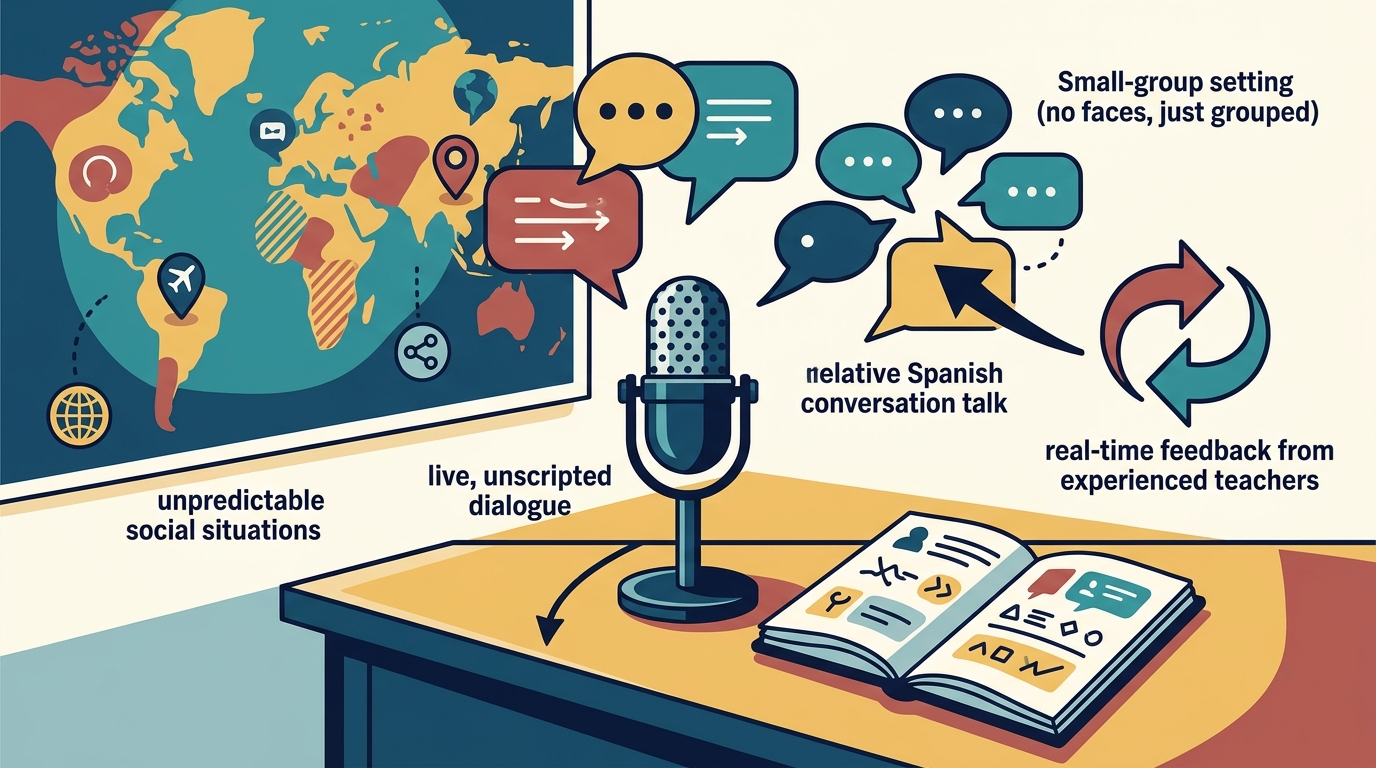
Adults should look for a Spanish program that prioritizes live, unscripted dialogue over rote memorization. The ideal environment offers small-group settings where students receive real-time feedback from experienced teachers. This approach ensures that learners build the confidence to handle unpredictable social situations, rather than just reciting textbook phrases. Pura Buena Onda focuses on this conversational method to help adults move from studying the language to actually speaking it.
The Limitations of Traditional Study Methods
Many adults start their Spanish journey with apps, textbooks, or grammar drills. These tools are useful for building a foundation of vocabulary and understanding rules. However, they often fail to prepare learners for the speed and unpredictability of real life. A student might know how to conjugate a verb in the present tense but freeze when a native speaker asks a follow-up question. This gap between knowing the language and using it is a common barrier for adult learners.
Traditional methods often treat language as a subject to be studied rather than a skill to be practiced. When a program focuses heavily on written exercises, students may feel comfortable with their knowledge but anxious about their ability to produce speech. The transition from passive recognition to active production requires a different type of practice. It demands a space where mistakes are part of the learning process, not failures.
Conversation practice is the bridge that connects theoretical knowledge to practical ability. It forces the brain to retrieve words and structures under pressure. This active retrieval strengthens neural pathways in a way that passive reading or listening cannot. By focusing on this active production, a program can help adults overcome the fear of speaking that often stalls progress.
Why Small Groups Matter for Speaking Confidence
Group size is a critical factor in the effectiveness of a conversation class. In large classes, it is easy to hide. Students may spend the entire session listening to the teacher or a few dominant voices. This limits their opportunity to practice and receive individual feedback. A smaller setting creates a more intimate and supportive environment. It encourages every participant to engage and contribute to the dialogue.
In a small-group setting of up to 6 students, the dynamic shifts significantly. Each student has a much higher chance of speaking during the session. The teacher can monitor individual progress and provide targeted corrections. This level of attention is difficult to achieve in larger cohorts. It allows the instructor to address specific pronunciation issues or grammatical errors as they happen, rather than waiting for a written assignment review.
The social aspect of a small group also reduces anxiety. When learners see that their peers are also making mistakes, the pressure to be perfect diminishes. This creates a safe space for experimentation. Students are more likely to try new vocabulary or complex sentence structures when they know the environment is non-judgmental. This psychological safety is essential for building the confidence needed to speak with strangers outside the classroom.
The Role of Real-Time Feedback and Correction
Feedback is the engine of language acquisition. Without it, learners may reinforce incorrect habits without realizing it. In a conversation-focused program, teachers provide real-time corrections that guide students toward more natural phrasing. This immediate feedback loop helps learners understand not just what is wrong, but why it is wrong and how to fix it. It turns mistakes into valuable learning moments.
Effective correction is not about shaming students for errors. It is about guiding them toward accuracy and naturalness. A skilled teacher knows how to interrupt a conversation gently to clarify a point or suggest a better word choice. This technique helps students internalize correct usage without breaking the flow of the dialogue. Over time, these small adjustments lead to significant improvements in fluency and accuracy.
At Pura Buena Onda, teachers are trained to provide this kind of supportive feedback. They focus on helping students sound more natural, not just grammatically correct. This distinction is important because native speakers often use informal structures that textbooks do not cover. By learning these nuances in a live conversation, students gain a deeper understanding of how the language is actually used in daily life.
Building Consistency Through Flexible Scheduling
Consistency is more important than intensity when learning a language. Adult learners often have busy schedules, making it difficult to commit to rigid class times. A program that offers flexible scheduling options can help students maintain their momentum. When classes fit into a learner's routine, they are more likely to attend regularly. This regular exposure is key to retaining new vocabulary and structures.
Flexible scheduling also allows students to choose the frequency that works best for them. Some may prefer multiple classes per week for faster progress, while others may find one class per week sufficient to stay engaged. The ability to adjust the schedule as life changes prevents burnout. It ensures that language learning remains a sustainable part of the learner's lifestyle rather than a stressful obligation.
Key Takeaways
- Live conversation practice is essential for bridging the gap between studying Spanish and actually speaking it.
- Small-group settings of up to 6 students provide more speaking time and individualized feedback than large classes.
- Real-time correction from experienced teachers helps learners develop natural phrasing and accuracy.
- Flexible scheduling supports consistency, which is crucial for long-term language acquisition.
- A non-judgmental environment reduces anxiety and encourages students to take risks with their speech.
- Focus on active production rather than passive recognition to build true conversational confidence.
Frequently Asked Questions
Do I need prior Spanish knowledge to join a conversation class?
No, you do not need prior Spanish knowledge to start. Beginner classes are designed for those with no previous experience. The goal is to build foundational speaking skills from the ground up.
How many students are in a small-group class?
Small-group classes typically include up to 6 students. This size ensures that each participant has ample opportunity to speak and receive feedback.
Is conversation practice better than grammar study?
Both are important, but they serve different purposes. Grammar study provides the rules, while conversation practice applies them in real-time. For speaking skills, conversation practice is essential.
Can I take classes online?
Yes, Pura Buena Onda offers 100% online classes. This format allows students from anywhere to participate in live conversation sessions.
How long does it take to become conversational?
Language learning is highly individual. Progress depends on consistency, exposure, and practice. Conversational confidence often takes sustained practice over a longer period, roughly two years for many learners depending on goals and consistency.
Start Your Conversational Journey
Choosing the right program is the first step toward becoming a confident Spanish speaker. Look for a school that prioritizes live dialogue, small groups, and real-time feedback. Pura Buena Onda has been creating a relaxed, fun, and non-judgmental environment for 19 years. We help adults move from studying Spanish to speaking it with confidence. To plan your visit, schedule a free phone consult with our team.