

Adults who attempt to speak Spanish often hit a frustrating plateau where they understand more than they can say. According to recent language acquisition data, the primary barrier for mature learners is not a lack of vocabulary, but the persistence of native-language interference patterns that block fluid communication. This guide breaks down the most frequent errors and provides concrete methods to eliminate them, helping you move from textbook hesitation to natural conversation.
False Friends and False Cognates
One of the most embarrassing hurdles for adult learners is the trap of false friends. These are words that look identical or similar in English and Spanish but have completely different meanings. For example, the word "actual" in Spanish does not mean "actual" in English; it means "current" or "present." Using it incorrectly can lead to significant confusion in professional or casual settings.
Another common error involves the word "embarazada." Many learners assume it means "embarrassed," but it actually means "pregnant." This mistake is so prevalent that it has become a staple of language learning humor. To fix this, you must stop translating word-for-word and start learning phrases in context. Our blog frequently highlights these specific linguistic traps to help you avoid them.
Adults often rely on their existing English vocabulary to guess Spanish meanings. This shortcut fails when the words are false friends. The solution is to build a mental database of correct pairings through repetition. When you encounter a new word, do not guess its meaning based on English. Instead, verify it immediately. This habit prevents the formation of bad habits that are difficult to unlearn later.
The Ser vs. Estar Trap
Perhaps the most notorious challenge in Spanish grammar is choosing between "ser" and "estar." Both translate to "to be" in English, but they are used in fundamentally different contexts. Ser is used for permanent characteristics, identity, and origin. Estar is used for temporary states, locations, and ongoing actions.
Consider the sentence "I am tired." In Spanish, this is "Estoy cansado." You use "estar" because tiredness is a temporary state. However, if you say "I am tall," you use "ser" because height is generally considered a permanent characteristic. This distinction does not exist in English, which is why adult brains struggle to categorize these concepts automatically.
To master this, you need a clear framework. Ser is for what you are. Estar is for how you are or where you are. A helpful mnemonic is the DOCTOR acronym for Ser: Description, Occupation, Characteristic, Time, Origin, and Relationship. For Estar, think of LOCATION and EMOTION. Practicing these distinctions in real-time conversation is the only way to internalize them. Our online classes provide the necessary environment to practice these nuances with native speakers who can correct you instantly.
Gendering Nouns Incorrectly
Spanish is a gendered language, meaning every noun is either masculine or feminine. This concept does not exist in English, making it a significant cognitive hurdle for adult learners. A common mistake is assuming that all words ending in "-o" are masculine and all words ending in "-a" are feminine. While this rule holds true for the majority of nouns, there are notable exceptions.
For instance, the word "mano" (hand) is feminine, despite ending in "-o." It is "la mano," not "el mano." Similarly, "día" (day) is masculine, despite ending in "-a." It is "el día," not "la día." These exceptions can be frustrating, but they are manageable with focused study. Our Patreon community offers deep dives into these irregularities, helping you memorize the exceptions alongside the rules.
Another frequent error is mismatching the gender of the adjective with the noun it describes. If you call a table "mesa" (feminine), you must say "la mesa roja," not "el mesa rojo." Adjectives must agree in both gender and number with the nouns they modify. This agreement is automatic for native speakers but requires conscious effort for learners. Writing sentences and checking your agreements is a vital part of the learning process.
Pronunciation
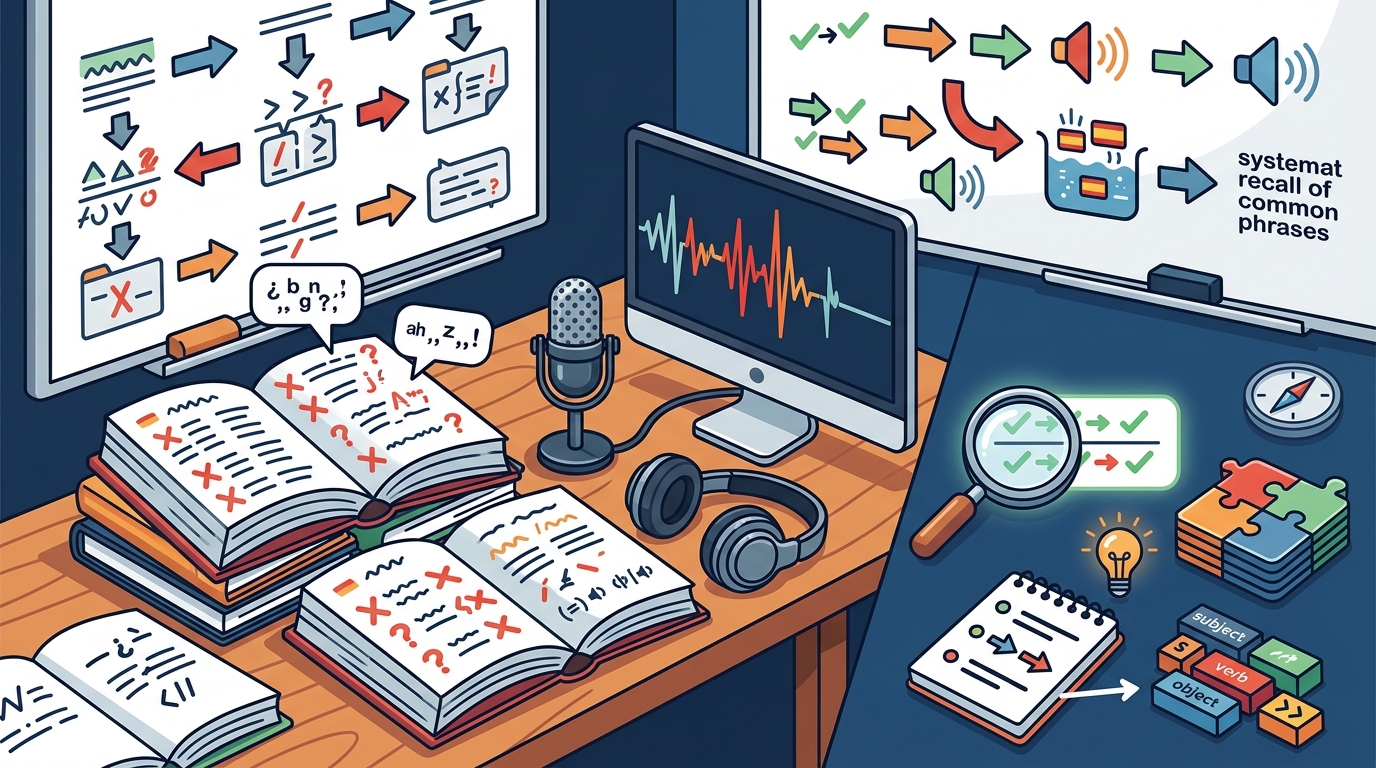
Adults often carry English pronunciation habits into Spanish, which can make certain words harder to understand. Spanish pronunciation patterns differ from English, so developing a more natural accent requires listening closely to how native speakers pronounce words and practicing those sounds in context.
To improve your pronunciation, listen actively and mimic native speakers. Our teachers are native speakers from various Spanish-speaking countries, providing you with exposure to different accents and pronunciation styles. Listening to their corrections and repeating after them is an effective way to refine your pronunciation. Pronunciation is a physical skill that improves with consistent practice.
Formality Levels and Tu vs. Usted
Spanish has two main ways to say "you": "tú" and "usted." "Tú" is informal and used with friends, family, and peers. "Usted" is formal and used with strangers, elders, or in professional settings. Using the wrong form can be seen as disrespectful or overly familiar. This is a subtle social cue that adult learners often miss because English uses the same word for both.
In many Spanish-speaking countries, the line between "tú" and "usted" can be blurry. In some regions, "usted" is used more frequently with older people, even if you know them well. In others, "tú" is used almost exclusively in casual conversation. Understanding the local norms is crucial. Our approach emphasizes cultural context alongside grammar, ensuring you know not just what to say, but when to say it.
Another common mistake is conjugating verbs incorrectly when switching between "tú" and "usted." The verb endings change completely. For example, "hablar" (to speak) becomes "hablas" for "tú" and "habla" for "usted." Mixing these up can confuse your listener about who you are talking about. Practicing these conjugations in context is essential. Our 2026 group class schedule offers regular opportunities to practice these distinctions in a supportive environment.
Learning Method Comparison
Choosing the right learning method is critical for overcoming these mistakes. Different approaches offer different benefits. The table below compares common methods to help you decide which fits your needs.
| Method | Best For | Pros | Cons |
|---|---|---|---|
| Small-Group Classes | Real-time feedback | Interactive, social, immediate correction | Scheduled times, group pace |
| Private Classes | Personalized attention | Flexible, tailored to your level | Higher cost, less peer interaction |
| Semi-Private Classes | Balanced interaction | Cost-effective, moderate practice | Less individual speaking time |
| Bootcamp | Rapid progress | Intensive, structured, community support | High time commitment, intense |
Each method has its place in your learning journey. Small-group classes offer the best balance of cost and interaction. Private classes are ideal for addressing specific weaknesses. The Bootcamp is perfect for those who need a structured push to break through a plateau. Check our rates to find the option that fits your budget and goals.
Key Takeaways
- Avoid False Friends: Never guess the meaning of a Spanish word based on English. Verify it every time to prevent embarrassing mistakes.
- Master Ser vs. Estar: Learn how "ser" and "estar" are used in different contexts and practice applying them in conversation.
- Respect Gender Rules: Learn the gender of every noun you encounter. Adjectives must match the noun in gender and number.
- Practice Pronunciation: Listen closely to native speakers and practice reproducing their pronunciation patterns.
- Know Your Audience: Learn when "tú" and "usted" are appropriate based on context and regional norms.
- Get Real-Time Feedback: Live interaction gives you opportunities to receive immediate feedback on pronunciation and grammar.
- Embrace Mistakes: Making errors is part of the learning process. Our community at Pura Buena Onda is a safe space to practice without judgment.
Frequently Asked Questions
How long does it take to stop making common Spanish mistakes?
Progress varies by individual, but consistent practice with native speakers can significantly reduce errors within 3 to 6 months. The key is immediate feedback to prevent bad habits from forming.
Is it better to learn Spanish online or in person?
Both methods have benefits. Online classes offer flexibility and accessibility. In-person classes provide immersive social interaction. Our online classes are designed to mimic the benefits of in-person learning through active conversation.
Why do I keep confusing "ser" and "estar"?
This is because English uses one verb for both concepts. Your brain is trying to map two concepts onto one word. You must consciously learn the rules for each. Practice is the only way to make it automatic.
Can I learn Spanish without memorizing grammar rules?
You can acquire grammar intuitively through exposure, but understanding the rules accelerates the process. Knowing the rules helps you self-correct when you make a mistake. Our blog explains these rules in simple terms.
What is the best way to improve my Spanish pronunciation?
Listen closely to native speakers and practice reproducing the sounds and rhythms you hear. Our teachers provide exposure to authentic pronunciation and a variety of Spanish-speaking accents.
Do I need to know Spanish before joining a class?
No. We offer classes for all levels, from absolute beginners to advanced speakers. Our 2026 schedule includes options for every proficiency level.
How does the 90-Day Bootcamp help with common mistakes?
The Bootcamp provides intensive, daily practice that forces you to confront and correct your errors. The structured environment and community support keep you accountable. Join the Bootcamp to accelerate your progress.
Start Speaking Today
Stop letting fear of mistakes hold you back. The best way to fix common Spanish speaking errors is to start speaking now. Contact us to schedule a free consultation. Discover how Pura Buena Onda can help you achieve fluency through real conversation.